Laffer Curve/
Reagonomics/
Trickle-down/
Universal B.I.

(Econ 101 for Fiat Currency)

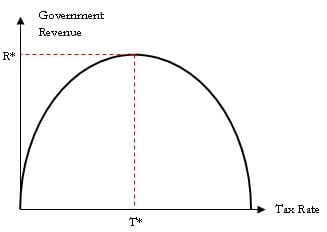
After observing that zero taxes give the government zero and 100% taxes make the incentive to work zero, the (dubious )curve shown was sketched.

In a two-party system, political combatants shout "tax the rich; redistribute the wealth" or "all taxes do is kill jobs". Nobody acts as a referee, understanding what is really happening.


Try changing tax rates and government efficiency below to explore what "perturbation theory" reveals about their effects near actual 2024 conditions:
Inflation was 2.4%/yr, prime interest rate was 7.5%/yr, unemployment was 6.7% and Supply and Demand both equaled GDP of $2241 Billion. GDP growth rate has been near 2%/yr.
detail


Shifting Capital to The GST
to Implement
Universal Basic Income.

The proposal - expand the
$2100 Billion holdings of capital in Canadian Pension Plans so dividend/interest income will reduce the current 8.4 to one income disparity. ( 8.4 to one below). qwrty You may shift capital above, and you may add/subtract a portion of these taxes: bottHalf midThrd topTier
GDP Growth: 0.0% Inflation 2.4%/yr
Total Income Tax: $ 555[ 555Bn 2024]. otherTax
Some capital will shift away from already-wealthy taxpayers, but there will be more demand - buyers have more to spend. UBI Capital operates Supply-Side instead of "tax and spend".


The Supply and Demand elasticities below multiply the effect:
Elasticity= (%Quantity change / %Price change).
Supply -o- and Demand -o- equalize:
splyElasty dmndElasty
GDP Growth: 0.0% Inflation 2.4%/yr

Supply is shifted by SpplyShift%=0.00%
and
demand by -0.00% in these equations:
PriceShift% ≈
½( DmndShift% DmndElasty + SpplyShift% SpplyElasty )
GDP[1] ≈ GDP[0]*(1+PriceShift%/100)

Central Bank Policy:
-o-keyRate
Production Input: Labor & Skillsets
-o-
Second Input: Capital & Machinery
-o-govtEffncy
-----------------------
corpTax -o--corpTaxElasty
GDP Growth: 0.0% Inflation 2.4%/yr
Third Input: Land & Resources(>$19Tn)
Entrepreneurship
entrprnrshpElasty

Algorithm Log: Average initial gross income = $70441.0000 Total Cap $ 20206.00000 Bn Ave Dividend = 0.00000k =>>Personal Taxes $110.x% Corporate: $110Bn. Other: $154.6Bn.
=>>Disparity Low Half: $110.0Bn, Mid Third: $110.00Bn, Top Tier: $110.000Bn,
=>>Total debt $...
==Above: UBI + 2024 Data==
?? Perturbations: Incomes: Low Half: $10.0Bn, Mid Third: $0.0Bn, Top Tier:$0.0Bn
=>>Taxes: Low: $110Bn, Mid: $110Bn, Top: $110Bn,

UBI Labor Reduction: We assume UBI of $ubiSplyDragBn adds to demand. (ubiSplyDrag1696MBaskets)
=> The Labor/Skillsets slider shows a supply reduction of ubiSplyBsktsMBaskets.
Government "Burden": Total Taxes (above) changed (change*100/dcyl.gdpVal).toFixed(1) % of GDP $ (dcyl.gdpVal/1E9).toFixed() Bn or (change/160.9E6).toFixed(2) MBaskets.
=> Government Services opinion - yyy
GDP Growth: 0.0% Inflation 2.4%/yr
Corporate Tax: Changes $110Bn, Elasticity: Supply Change: MBaskets/yr.
Other Taxes: $110Bn,
Key Rate Effect: ..% of ?? total debt = (this.dmndBskts).toFixed(1)MBaskets of demand.
GDP Growth: 0.0% Inflation 2.4%/yr
Supply and Demand equalize:GDP ($2241Bn)= 13928 MBaskets in 2024.
Sliders for and give the 2025 GDP: $(dcyl.gdpVal*gdp2025ShiftPct/1E9).toFixed()Bn in 2024 "constant dollars".


PriceShift% ≈ ½(DmndShift%/DmndElasty + SpplyShift%/SpplyElasty) and
GDP[1] ≈ GDP[0]*(1+PriceShift%/100) give the 2025 GDP: $2241Bn in 2024 "constant dollars";

Elasticity sliders 2025 Personal Tax change $0.00Bn, Corporate: $0.000Bn. Other: $-0.000Bn.
Assume inflation would have remained at 2.4%/yr. These changes give 2.4%/yr


UBI Proposal:
The CPP fund already pays out disability pensions, and GST pays low-income households $589 monthly plus $231 per minor. GST only transfers funds between consumers (demand-side) whereas the CPP plan holds capital that works supply-side. It pays dividends and interest into the plan and keeps ahead of inflation.

The holdings of the plan are large and well-managed (unlike many others) and could be used to both provide capital for the overall economy and increase GST payouts without taxing consumption.

A major challenge is to persuade the political right that times have changed and implementing even more Reaganomics won't work as in the past - they shout "tax and spend".

A second challenge is to persuade the political left not to spend the capital that is in sovereign wealth funds. Their base is families who have not experienced saving.

The first key is to understand that money is no longer backed by gold et. al. but is now "printed" by Central Banks as simple journal entries.

Taxation and the Key Interest Rate now pull it back out of the economy and prevent inflation. Taxes do not fund governments, as Laffer et. al. assumed.

Thus a Sovereign Wealth Fund can use newly created money to purchase low-Beta stocks that will go to the Assets side of the balance sheet and grow to offset the printed-money Liabilities side. No unchecked growth of debt.

The second key is to buy shares from "the rich" rather than confiscating wealth with taxation; and to select firms who are already winners.

That shifts private capital into higher risk/reward investments, fostering entrepreneurism. Sovereign Wealth funds around the world are already doing that.

Its charter should prevent distributing more UBI than is coming in from publically declared dividends of publically traded shares. Thus the Balance Sheet will grow while UBI will shift taxation onto people who like spending.

Presumably sellers of stocks to the Fund will re-invest the proceeds. The new money does not become available as disposable income except via employment constructing capital items. That produces future increase in goods and services, and the entrepreneurial spirit is typically triggered when people see "good times".


(Sketchy) Derivation:

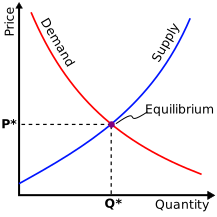
The two curves may be linearized with respect to an origin at p and Q:

(Demand - Q) Q (Price - p) p * DmndElasty
and
(Supply -Q) Q (Price - p) p * SpplyElasty

Next year, GDP will shift so that Supply and Demand reach a new equilbrium Price that takes into account shifts Q in Goods and Services ( DmndShift%≈ (Demand - Q) Q and SpplyShift%= (Supply -Q) Q ). This price must also be in equilibrium (equal).

Such shifts will have been specified by the user's sliders and by the historical 3%/yr growth rate of GDP (supply side). The left hand sides of the above equations thus become equal, with a new Q (Supply or Demand) value and a new p (Price) value.

Moving the elasticities, established by the sliders above, to the LHS makes the RHSides become equal instead:
DmndShift% DmndElasty (Price - p) p
and
SpplyShift% SpplyElasty (Price - p) p
Adding the two equations we get
(Price - p) p ≈ PriceShift% ≈
½( DmndShift% DmndElasty + SpplyShift% SpplyElasty )
The resulting Price on the LHS will be the new GDP:
GDP ≅ p*(1+PriceShift%/100)
where PriceShift% is 100*(Price - p)/p from the various sliders.

PriceShift%/100 is the approximate GDP growth and
Inflation is approximately PriceShift%/100 - SpplyShift%/100.


New Role of Taxation

The velocity of money V, or the speed at which currency changes hands, is defined by the formula V= PQ M where P is price, Q is output, and M is money supply), representing how many times a unit of currency is used to purchase goods. Note that the top, PQ is also the GDP.

Thus a tax rate of 1 V is required to balance money creation and taxation.

M2 was $2600Bn at the end of 2024 and GDP was $2241Bn, so V=1.12 and taxation could only be 12% less than the rate of money creation. Federal Goverment revenue totaled $459.5Bn or 20.5% of GDP and spending was 23%, predicting 2.5%/yr inflation (2.4 observed).


The Low Beta Criterion

Options Trading is a proven way of managing risk, and it shows up in News reports as "triple witching" days etc. Two parameters, Alpha and Beta, measure growth rate and risk respectively.

ETFs which hold stocks with the lowest Beta/risk typically grow at 6%/yr, which would result in a positive balance sheet if the fund simply "prints" money for their purchase and does not distribute it to GST recipients.

Such ETFs also typically pay out 3%/yr in cash, which we propose should be paid out as UBI/GST.

The EMA200 Example:

The Fund should only purchase stocks when they are below a trend line representing the middle of the rising volatility band. Something like the Exponential Moving Average could be used to define where the middle is, recognizing that it lags the trend line by over half a year.

This ensures that the Balance Sheet averages a Rate Of Return that is equal to or better than average, and it tends to push up mature share prices, crowding Entrepreneurally - minded investors into higher-risk stocks.

The down-side is that it further reduces Beta of the shares the Fund already holds, so Fund Managers would need to avoid getting locked into a small group of investments.


Base-line: The 2024 Economy

GDP equals spending (Demand Side);
=> 23% spending by Governments, the revenue for which was
    > Personal Income Tax 46.4%,
    > Non-Resident Income Tax: 2.9%
    > Corporate Income Tax: 21.0%,
    > Other: (GST, energy taxes, etc.) 29.5%.
    =>>Federal revenue (Google AI): $459.6Bn. Provincial totals: $180.6Bn. We will use sliders to change these percentages, and will assume revenues will change by the same percentage as GDP does.
=> 77% requiring capital: ($20,200Bn)
-----------------------------------------
The need for investment/savings drives the "tax and spend" objection of the political right.
However, lower labor cost gives employers more to invest when wages do not have to cover services and infrastructure that are public.
(See "Land, Labor and Capital" below.)
-----------------------------------------
    >55% of the GDP was consumption & debt
    =>>Shelter accounted for 32.1% ($396Bn) and food 15.7% ($192Bn) of consumption.
    =>>Household mortgages are a large portion of debt.
    =>>The total value of Canada's housing assets was $4200 Bn in 2024, so the equivalent of rent would be .396/4.2 or 9.4%/yr.
    =>>~1/3 of households (~5 million) rent their homes.
    =>>Household debt was 176.4% of disposable (gross-tax) income. This ratio is similar over income levels, and the average rate was 4.2% more than the Key Rate below.
    >and 21% was investment
    =>> Households saved approximately $3785 each: 3.8% of GDP, totaling $85.2 billion.
    =>>Savings are what is left over after Consumption, Interest and Taxes; and
    =>>by the Savings Identity, it is part of overall Investment of 21% of GDP.
    >and 1% net exports.
-----------------------------------------
Land, Labor and Capital are the inputs to the following supply side of the GDP; those parties who receive what is spent above:

The average net profit margin for capital investments was 8.54%. (Gross across all industries 36.56%)
Thus total capital is about $20,206Bn, approximated by   
non-Government 77% of equilibrium between supply and demand in 2024   
divided by 8.54% return On Capital from web data.
Total asset value of Canadian businesses was $17 trillion as of 2022.
($2.5 trillion foreign-controlled.)
We will use $20 trillion working capital.
-----------------------------------------
GDP also equals income (Supply Side):
    > distributed over 31.814 million tax returns (22.5 million households).
    >Corporate Income comes from Consumer spending
    =>>Part of it is diverted into Savings/Investment, but much of the $20,200Bn investment is financed by debt.
    > Average Individual Gross Income: $70.4k from $Bn 2241 GDP/ 31.8 million tax returns.
    >